








The rural livelihoods and the national food security are still dependent on agriculture. Timely access to resources, fair access to finances, and predictable government assistance are essential to farmers to remain productive. Social welfare and agricultural assistance programs have become more important over the past years as costs have increased and economic pressures have been on the rise.
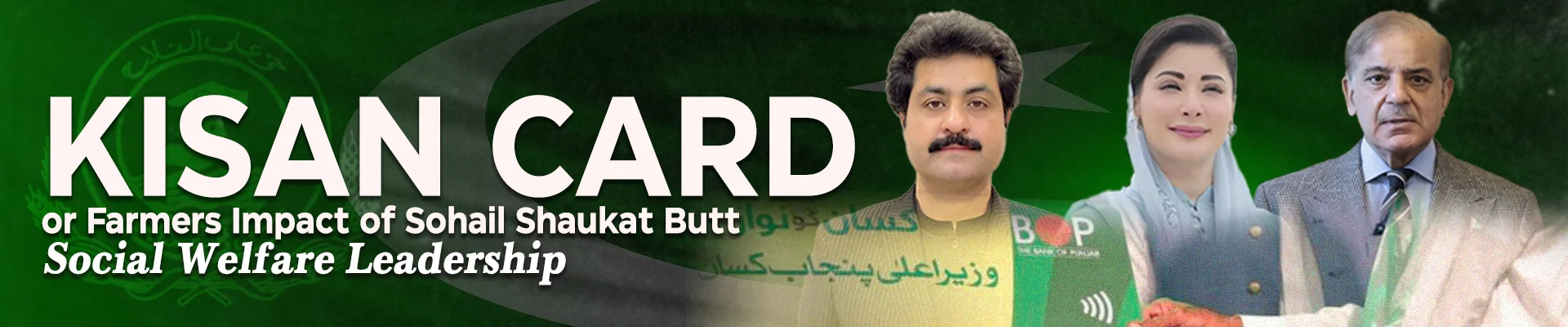
One of these efforts, which can be discussed as a significant move towards empowering agricultural communities, is the distribution of the Kisan Card to farmers. The initiative has been broadened in its effects under Sohail Shaukat Butt, the Minister of the Social Welfare Department, with systematic arrangements, clear implementation, and community-oriented outcomes.
Sohail Shaukat Butt has been visible in the enhanced social welfare systems in several geographical locations. His strategy is focused on direct support, empowering the farmers and sustainable development. His activities aid vulnerable groups, enhance the stability of rural areas and the access to necessities through collaborations with Bait ul Mal and other government agencies. This wider purpose of enhancing livelihood and strengthening trust between the institutions and citizens is reflected in the Kisan Card distribution to farmers.
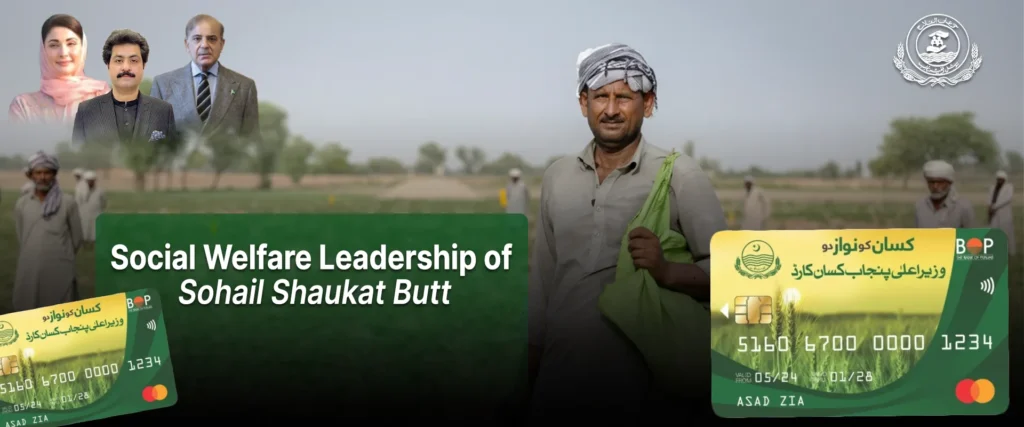
Social Welfare Leadership of Sohail Shaukat Butt
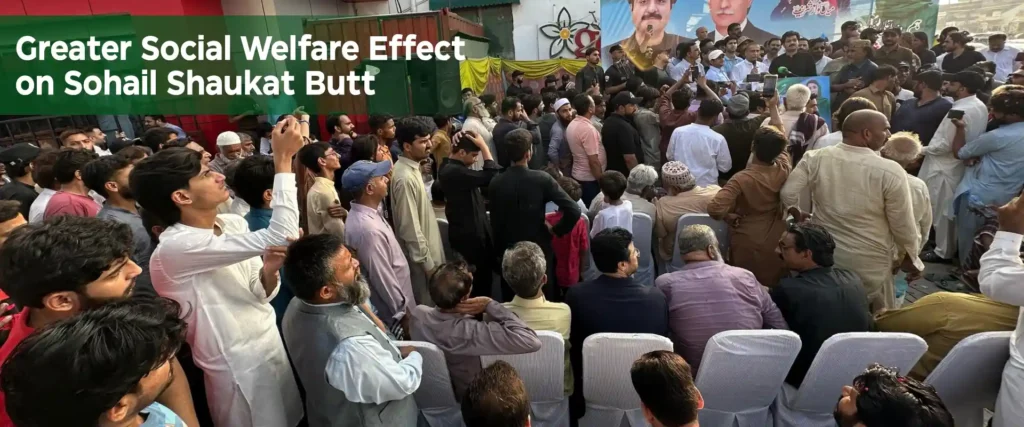
Sohail Shaukat Butt is the Minister of the Social Welfare Department that aims at people-centred governance. His leadership approach is responsible, responsive and problem-centred. His policies focus on welfare planning on the long term as opposed to short-term solutions. These policies are meant to take care of the farmers, low-income families, communities of labour, and people of the rural areas in a balanced way.
His programs aim at raising the living standards by providing direct aid programmes, provision of skills development, financial relief and increase of infrastructure. His leadership empowers social protection systems by taking care of current needs and the stability of the future. Moreover, his engagement in various cities shows his focus on learning about the regional issues and responding to them in a more specific way.
Sohail Shaukat Butt has increased the scope of social welfare programs through regular fieldwork, monitoring of the project and working with local governments. These works demonstrate a bigger picture of inclusive development in which economic development is combined with social responsibility.
Part in Farmer and Community Support Role of Baitulmal
Bait ul Mal is a key institution in providing both financial and social services to the needy population. It has the mandate of assisting the low-income families, providing medical aid, educational programs, and emergency relief. Within the agricultural sector, Bait ul Mal has been playing a vital role in making sure that farmers are given specific aid at tough economic times.
Bait ul Mal, through its coordination with the Social Welfare Department, is involved in the agricultural relief programs which assist farmers to handle the cost of production. Such initiatives are financial assistance, subsidies, and assistance in agriculture. The incorporation of Bait ul Mal in programs of assisting farmers makes sure that the recipients of the assistance received are deserving and that the assistance has accountability and fairness.
These programs enhance a systematic safety net among the vulnerable populations by ensuring stronger collaboration between government departments and welfare institutions. This is a more effective method of coordination in agricultural aid, and it enhances the confidence of the masses in welfare.
Kisan Card Distribution to Farmers and its objective
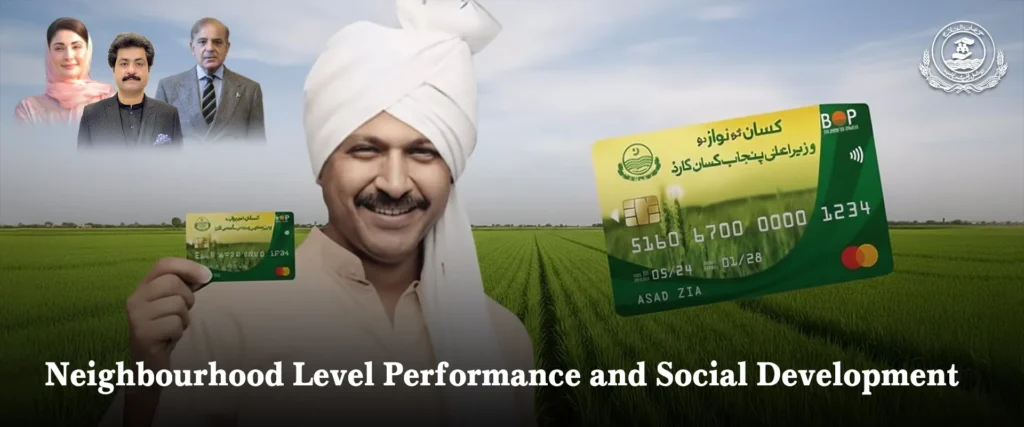
Farmers have been offered a Kisan Card distribution to give them organized financial and agricultural assistance. The program enables farmers to receive subsidies, farm inputs and financial aid in a simplified manner. The Kisan Card is aimed at guaranteeing that people do not rely on informal lenders and providing fair access to necessary resources.
In this program, farmers are able to access seeds, fertilizers, irrigation support and other farming inputs at subsidized prices. This saves on the cost of operation and enhances productivity. Also, the card aids farmers with cost management at the time of major planting and harvesting. The program enhances the economic stability in rural communities through simplifications in access to resources.
There is more to the financial relief; the Kisan Card program also encourages transparency in the allocation of resources. The support is given to farmers on the basis of the attested eligibility requirements; this enhances equity and limits abuse. This formal system increases the level of trust between the farmers and the institutions of the people, as well as accountability.
The effects of Kisan Card Distribution are as follows
Access to Financial Support and Subsidies
Kisan Card directly benefits the farmers by granting them access to subsidies and regulated credit possibilities. Such funding will ease the experiences of increased agricultural expenses. The farmers will not need to take expensive loans with interest or unreliable sources of funds to buy the necessary supplies. Consequently, they have more control over budgeting and crop planning.
In addition, financial support enables farmers to escape the delay in planting. This enhances the potential of yielding and provides enhanced market timing. In the long run, this financial stability promotes the economy of the rural area and sustainable agriculture.
Farming and Agricultural Resources Support
Access to quality farm inputs is necessary for productive farming. By means of the Kisan Card that is given to farmers, the beneficiaries are provided with better access to roots, seeds and farming machinery. The resources contribute to improving the quality of crops, efficiency and wastage.
Also, access to irrigation instruments and soil improvement materials is enhanced, which will promote sustainable land management. The farmers enjoy an improved practice in farming, which leads to the sustainability of the environment in the long run. Such a combination of the presence of resources and technical assistance promotes more resilient agricultural systems.
Long-term Rural Communities Benefits
The Kisan Card program is not just beneficial to individual farmers. The economic gains in the rural areas are more wide-ranging since agricultural productivity improves. Increased crop production generates job opportunities, boosts local marketplaces and enhances household incomes.
With time, these upsides facilitate rural development and alleviate the pressure of urban migration. The program helps to bring a balance to the economic growth and community resilience by stabilizing farming livelihoods.
Contributions of Sohail Shaukat Butt in More than One City
Social Welfare Projects in Various Areas
Sohail Shaukat Butt has spread social welfare programs in different cities with special emphasis on uplifting the community. The projects deal with the reduction of poverty, education aid, access to health and emergency relief. Every program represents the knowledge of the local requirements and economic state of affairs.
His leadership style of decentralizing welfare services makes sure that the assistance gives access to the city and rural citizens. This is a regional outreach that enhances the local infrastructure and fair development.
In Aid of Farmers, Laborers and Low-income Families
In addition to the agricultural activities, Sohail Shaukat Butt has programs on labour welfare, income support programs, and family assistance schemes. These initiatives include relief, job training, and job placement among the poor groups.
Empowerment programs for women, youth, and small business owners also empower economic participation. His policies encourage inclusive development as they help to support various sectors of society, as well as minimize income inequalities.
Building On a Strong Public Trust by Enhancing Open Governance
Another major pillar of the Sohail Shaukat Butt governance is transparency. Welfare programs have accountability mechanisms that ensure that they are distributed fairly. Program credibility is achieved through benefit verification procedures, public reporting and monitoring systems.
This transparency commitment will create trust among the people and will bring about more involvement with the community. The belief in the social welfare institutions keeps increasing as citizens witness material gains.
Agricultural Relief Programs and Economic Stability
Relief programs in agriculture are crucial in ensuring food security and economic stability in rural regions. The financial pressure on farmers has risen due to environmental issues like the rising cost of production and climate challenges. Structured assistance programs here give long-needed help that stabilizes income and keeps productivity.
A strategy to counter these hurdles is the Kisan Card being given to the farmers. The program enhances the ability of farmers to deal with risks by minimizing the cost burden and increasing their access to resources. This strength helps to stabilize food supply in the country and contributes to the overall development of the economy.
Also, better agricultural productivity is a plus to industries like transportation, food processing and retail. These spill-over effects boost economic activity in the various sectors.
Greater Social Welfare Effect on Sohail Shaukat Butt
The leadership of Sohail Shaukat Butt stretches to agricultural projects. His department has introduced programs that focus on education aid, healthcare aid, disability aid, and the reduction of poverty. These efforts enhance the living standards of the disadvantaged groups and enhance social integration.
Vocational training programs and education scholarships enable the youngsters with skills that make them employable. With the help of healthcare assistance programs, medical care is offered at reduced costs to the family, making medical help more affordable than in the case of low-income families. Disability support schemes enhance social inclusion and accessibility for persons with special needs.
The programs play a role in ensuring that the community develops holistically as they handle various aspects of social welfare. This is a combined strategy that promotes the stability of society and improves the quality of life in general.
Correspondence to Vision and Community Involvement
The actions of Sohail Shaukat Butt are associated with a powerful desire to serve the people, being a responsible leader, and being involved in the community. His work is focused on being responsive to the needs of the citizens, constant review of the program, and open communication.
Outreach campaigns, awareness programs and stakeholder consultations among the populace are what make welfare programs more in touch with the community priorities. This participatory practice will improve the effectiveness of the policy and promote mutual problem-solving.
Besides, the active communication with local leaders, farmers, and representatives of the community will enable us to discover emerging problems and optimize the solutions accordingly. This is an adaptive model of governance that enhances the sustainability of welfare programs.
Farmer Welfare: Sustainable Policies
Farmer welfare relies on the policy planning of the long-term economic, environmental, and social considerations. Kisan Card distribution among farmers is a viable policy model since it combines financial relief and agricultural development.
The program helps in sustainable agriculture by advancing the efficient utilization of resources, encouraging sustainable farming methods, and assisting in the adoption of technology. Farmers are benefited with tools and knowledge that enhance productivity and conservation of natural resources.
Also, there are policy instruments to access the market, stability of prices and efficiency of the supply chain that increase the incomes of farmers even more. All these activities make up a favourable agricultural environment.
Neighbourhood Level Performance and Social Development
Better farmer welfare at the community level results in more extensive social development. Families are able to invest in housing, healthcare and education due to the increased household incomes. This enhances living conditions and upward social mobility.
A robust rural economy brings down poverty rates and increases the resilience of the community to economic recessions. With the increase in agricultural output, there is an augmented demand in local businesses due to the rise in demand for goods and services.
The positive consequences in the long run lead to an fair regional growth and national prosperity.
Adversities and Constant Development
However, as much as the Kisan Card program has provided substantial outcomes, it is necessary to keep on improving. The need to distribute resources in time, increase the coverage of the programs, and make them more accessible online is a continuous priority.
Farmer and local stakeholder feedback will be used to pinpoint areas that can be improved. The involvement of the community enables policymakers to enhance the effectiveness of programs and tackle the arising challenges.
The leadership of Sohail Shaukat Butt attributes importance to flexibility and lifelong learning. This commitment helps in the transformation of welfare programs in the changing economic and social circumstances.
Leadership in Social Welfare and Agriculture
Good leadership is very decisive to the success of social welfare and agricultural programs. Leaders who put transparency, accountability, and citizen participation in their priorities build stronger public institutions.
The works of Sohail Shaukat Butt are an illustration of how committed leadership can make a significant change. The way he tried to develop welfare programs, help farmers, and build resilience in the communities demonstrates the significance of responsible governance.
His leadership brings about sustainable development and social progress by ensuring that policy objectives meet the community’s needs.
Conclusion
The Kisan Card among farmers is a major move towards supporting the livelihoods of farmers and the stability of rural communities. The initiative boosts the welfare and productivity of farmers through mechanisms of structured financial assistance, enhanced access to resources and transparent governance.
Social welfare programs are on the rise and spreading under the leadership of Sohail Shaukat Butt. His dedication to the service of the people, holistic development, and responsible governance are some of the factors that led to desirable results in various sectors.
With the changing agricultural issues, it is necessary to invest more in programs that support farmers. These initiatives can ensure economic growth and well-being in the long run by bettering collaboration among government departments, welfare institutions, and other communities through the augmentation of local populations.